
Livingston Projected Versus Actual Release
A projected or computed date is not the same as the moment a person leaves custody. For Missouri state sentences, the verified public data labels are Sentence-I Minimum Release Date and Sentence Maximum Release Date. The minimum is the conditional-release date. The maximum is when the full court term expires. Neither field should be renamed “actual release” unless another record documents that physical exit.
Livingston County detainees can be in a different situation. Most local detainees are held at Caldwell County Detention Center, with some at Daviess/DeKalb Regional Jail. A pretrial detainee has no sentence-based release date. Bond, a court order, dismissal, another hold, or transfer can decide when that booking ends. A jail-sentenced person’s expected date depends on the written sentence, jail credit, later court amendments, and the jail’s computation. The LCSO roster is useful for custody clues, but it is not a sentence calculator.
Find Livingston County Release Dates
Start by asking which agency’s custody and sentence are at issue. The Missouri Department of Corrections calculates state-prison dates. The court and physical jail are the key sources for a Livingston county-jail sentence. Federal cases use federal systems. Mixing those paths can produce a date tied to the wrong custody event.
- Identify whether the person is pretrial, serving a county-jail term, in MDOC custody, or under post-release supervision.
- For an active state case, search the MDOC Offender Web Search by the available name or identifier and compare the person carefully.
- If the person is fully discharged and absent from the active search, use the nightly DOC Sunshine file and match DOC ID, cause number, county, and sentence rows.
- For a Livingston jail term, read the Case.net judgment or sentencing entry, then ask the physical jail for its calculated release date and credited time.
- Ask whether another warrant, detainer, consecutive sentence, or transfer affects the expected exit.
- Recheck near the expected date and obtain the actual release record after the event.
The active MDOC search intentionally excludes discharged offenders. Its silence cannot establish a completed sentence. The Sunshine file covers people who are or have been supervised, but it is charge-level data and may contain many rows for one person. A Livingston County code on a sentence row does not by itself prove a booking in the former Livingston jail. For a named local release, the Livingston County release search provides the county, court, MOVANS, and records-request sequence.
A release-date request should preserve the agency’s own label. Ask MDOC whether the response is a conditional minimum, maximum expiration, parole date, or final discharge. For a contract-jail term, ask whether the figure includes credit already served and whether a later court order changed it. Also ask if the date ends confinement at that jail or sends the person to another custodian. These short questions prevent an eligibility date, a transfer date, and a true community release from being blended into one answer. Keep the access date with every web result because corrections calculations and case orders can change.
Livingston Minimum and Maximum Dates
Missouri’s DOC glossary gives the best public definitions. Minimum release means conditional release, not unconditional freedom or final discharge. Maximum release means the full court term expires. The distinction remains important when a person is released to parole or conditional supervision. The prison-door exit may be followed by a period in the community under DOC rules.
The Sunshine file includes the exact minimum and maximum sentence labels, plus sentence date, completed flag, probation fields, assigned place, and a location-function flag. A field assignment can support active community supervision, while an institution flag points to institutional placement. Yet one completed charge row does not prove every sentence in an aggregate case is complete. Match all rows by DOC ID and cause number before describing the person’s date.
The official glossary page illustrates the terms used for Livingston County state-sentence research:
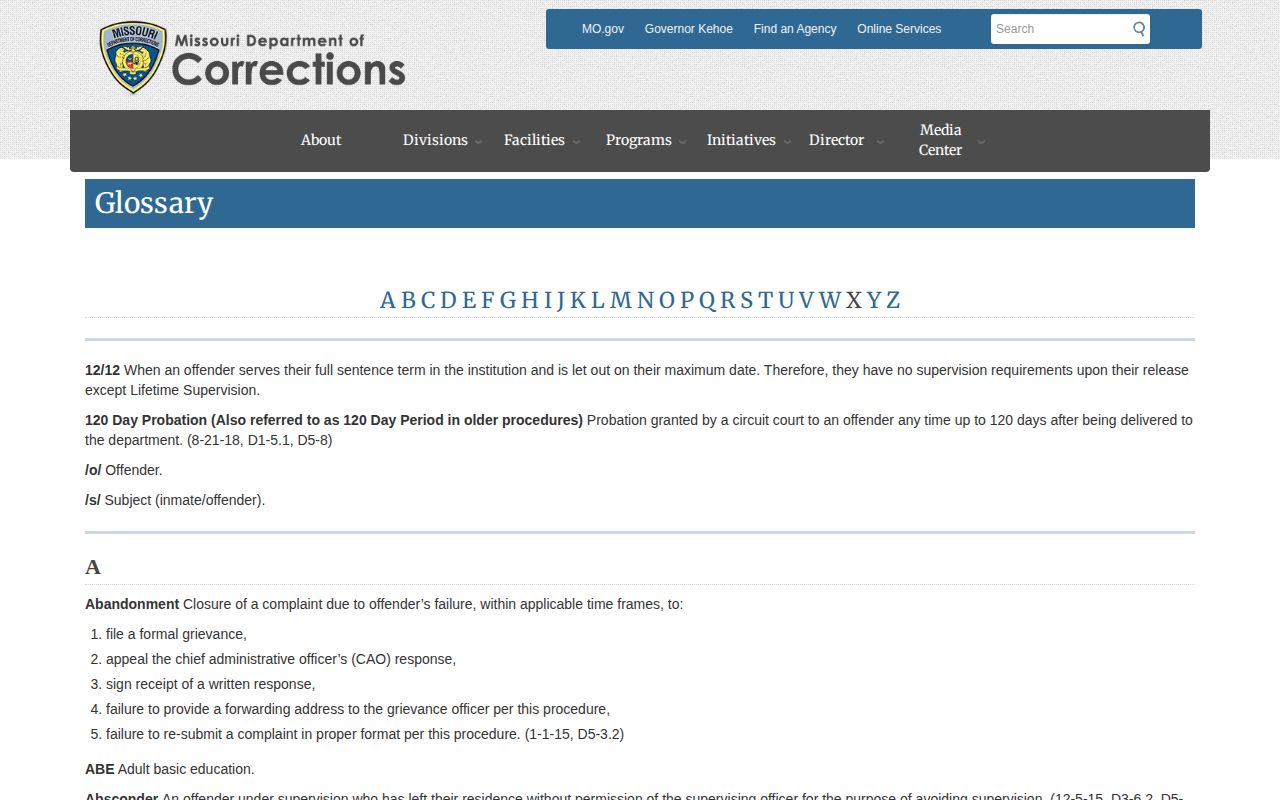
Those definitions should remain intact in any request or status summary. A minimum date is conditional, a maximum date is expiration, and the actual release requires its own evidence.
Missouri Conditional Release Structure
Missouri Revised Statute §558.011 divides eligible term sentences into a prison term and a conditional-release term. For a term of nine years or less, the conditional part is one-third. For more than nine through fifteen years, it is three years. For a term above fifteen years, it is five years. Exclusions and other minimum-term laws can change eligibility.
These fractions do not support a do-it-yourself release calculator. Sentencing dates, jail credit, concurrent or consecutive sentences, special minimums, program rules, and DOC computation all matter. Institutional misconduct can also lead the Parole Board, after the required process, to extend a conditional date toward the maximum. A person’s date must come from the sentence record and corrections calculation, not a simple subtraction.
Parole eligibility is also not a release promise. The Missouri Parole Board can consider conduct, adjustment, programs, and other relevant circumstances. A result may set a future release date or another hearing. That process is distinct from the statutory sentence fields, even when both affect when a person may leave prison.
Livingston Good-Time Release Rules
Section 558.041 authorizes eligible institutional good time through DOC policy and a superintendent’s recommendation for conduct or program participation. The statute does not publish one universal number of days earned per month. Credits can also be lost. Any claim that every Missouri prisoner earns a fixed daily or monthly amount would be unsupported.
Minimum prison terms are separate. Under §558.019, a dangerous-felony case can require service of an 85 percent minimum before eligibility, subject to the statute’s age-related alternative and other terms. The rule does not apply to every felony. Covered non-dangerous cases with qualifying prior unrelated prison commitments may carry 40, 50, or 80 percent floors. These percentages define eligibility limits, not a guaranteed exit day.
County-jail computation differs again. No Livingston-specific county good-time rate or weekend-release policy was located in the official sources reviewed. Use the sentencing order, credit for time already served, any amended order, and the physical jail’s record. Caldwell or DDRJ should be asked for the date it calculated and whether a hold or transfer changes the planned exit.
Livingston Release Dates and ECC
Earned Compliance Credit, or ECC, concerns supervision after release. It is not prison good time and does not move the earlier prison-door exit. Under §217.703, an eligible person who completes a full compliant calendar month on probation, parole, or conditional release may earn thirty days against the supervision term. Eligibility, restitution, and minimum-supervision requirements still apply. An absconder does not accrue the credit, and credits can be suspended or rescinded.
This distinction is the core Livingston County release-date angle. Four dates or events may coexist: conditional minimum, maximum expiration, actual physical release, and final supervision discharge after ECC or other action. A person may be out of prison but still subject to MDOC field supervision. Early discharge can then remove that person from the active offender search. Use the historical Sunshine data or a requested discharge record when the active search no longer returns the person.
| Date or credit | What it means |
|---|---|
| Minimum release date | The conditional-release date computed for the active sentence. |
| Maximum release date | The date the full court term expires. |
| Actual release | The documented time the person left a facility or one agency’s custody. |
| Institutional good time | Eligible prison credit under DOC policy and §558.041. |
| Earned Compliance Credit | Credit against an eligible post-release supervision term, not prison time. |
| Final discharge | The end of DOC supervision, separate from the prison exit. |
Why Livingston Release Dates Change
A date can move for legal, corrections, or custody reasons. The safest approach is to record the label and access date, then ask the agency that calculates it whether the field is still current. Do not infer the cause of a change from the date alone.
| Factor | Possible effect | Best confirmation |
|---|---|---|
| Institutional misconduct | Good time may be lost or conditional release may be extended after process. | MDOC and Parole Board records |
| Other warrant or detainer | The expected community release may become a transfer or continued hold. | Holding jail and requesting agency |
| Court amendment or credit | The legal sentence or credited time may change. | Written judgment and Case.net docket |
| Concurrent or consecutive terms | Several sentences may change the aggregate calculation. | MDOC sentence computation |
| Parole decision | A future release date or later hearing may result. | Missouri Parole Board record |
| Transfer | One agency’s custody ends without community release. | Release disposition and receiving agency |
A posted bond also does not equal the jail’s exit timestamp. Processing and another hold can delay release. For Livingston detainees housed outside the county, ask both LCSO and the physical jail what date and disposition each system recorded.
Confirm Livingston County Release Dates
Near the expected date, verify the calculation with the responsible office. For MDOC, the caseworker or Probation and Parole field officer can clarify a specific active status. For a county-jail sentence, call the physical jail and compare its answer with the judgment. Registering through the Livingston County VINE inmate check can provide a current SMS or email alert, but the alert remains agency-fed evidence rather than a universal custody certificate.
After the event, request the open portions of the admission and release record. Ask for release date and time, disposition, and destination or receiving agency. This distinguishes community release from transfer. If the expected date passed with no exit, ask about another hold, court action, or recalculation without guessing which one applies.