
Livingston 72-Hour Release Source
The official starting point is the Livingston County Sheriff’s Office Released Inmates filter. It offers Released and Current categories, sorting by name or date, newest-to-oldest or oldest-to-newest order, and a search by first or last name. The route supports a descending release-time sort. It does not include a 72-hour duration parameter.
No separate 72-hour, three-day, or weekend-release route appears in the sheriff’s interface or official sitemap. The sheriff also does not state the filter’s retention period, update cadence, or rolling window. Use the filter as a recent-release index, then compare any displayed dates with an exact three-day range. Do not label all results as people released during that period.
Check Livingston Three-Day Releases
Define the interval before searching. “Last 72 hours” means a moving period measured backward from a stated time, while “the last three calendar days” may cover different hours. A request made after a weekend should list the exact start and end date and time. That wording gives the sheriff or jail a clear interval and avoids a dispute over what “recent” means.
- Open the sheriff’s Released filter and sort by release date, newest first.
- Search the person’s first or last name, then compare each visible release time with the chosen 72-hour interval.
- Check the current roster only for a current-custody contrast and any text naming the jail that held the person.
- Contact LCSO and that jail. Ask whether the person left for the community or transferred to another custodian.
- Review MOVANS and Case.net for status and case disposition, then file a date-bounded request when the online trail is incomplete.
Use the Livingston County 24-Hour Releases process when only the same-day span matters. The narrower check uses the same official source but applies a shorter, separately defined interval.
Livingston 72-Hour Release Fields
A useful record must tie a person, booking event, and exit event together. The sheriff’s Released view was empty at capture, so its released-card field set could not be observed. The current roster’s visible fields should not be copied over as promises about released entries. For a reliable three-day list, request the fields the custodian maintains and specify that open electronic portions are preferred.
| Field | Use in a 72-Hour Check |
|---|---|
| Name, aliases, and releasable birth date | Separates people with similar names. |
| Booking number | Links the roster entry, jail file, and court case. |
| Admission date and time | Identifies the custody event that ended. |
| Custody facility | Points to Caldwell, DDRJ, or another agency holding physical-release details. |
| Release date and time | Shows whether the event falls within the exact three-day interval. |
| Release disposition or type | Distinguishes bond, time served, court order, transfer, or another outcome. |
| Destination or receiving agency | Reveals whether another agency’s custody continued. |
A booking photograph, age, charge, bond, and custody-site text are visible on current-custody cards. Their continued display after release was not verified. If a photo or another field is needed, name it in the request rather than assuming that the public three-day view contains it.
Livingston Weekend Release Checks
A 72-hour window can span a weekend or holiday closure, but it does not create an official county weekend list. Start with the web filter, note the date and time of the search, and preserve the identity details needed for follow-up. The LCSO administrative office publishes weekday hours and closes for major holidays. The physical contract jail may hold the information about the actual exit.
For a Monday check, a request might name midnight Friday through midnight Monday, or another exact interval that fits the question. Ask for all Livingston bookings released during those hours, with date, time, disposition, physical facility, and destination. A custodian need not create a custom report the agency does not maintain, so request existing open electronic fields and a cost estimate.
Missouri law requires the records custodian to act on a request by the end of the third business day. That is a response deadline, not a promise that all records will be produced within three days. A reasonable delay may take longer if the custodian explains the reason and earliest available date.
Record the source and retrieval time for every result. A three-day span can cross changes in the web filter, a jail transfer, and a court event. Keeping those timestamps separate makes it easier to explain why a status alert, roster result, and formal release time do not appear at the same moment. The release record should control the exact exit time.
Livingston Released Filter Limits
The Released filter returned “Inmate Roster (0)” on July 26, 2026. That captured state cannot be turned into a Livingston County release statistic. It may reflect the web view’s undisclosed cadence or retention, or simply the result available at that moment. It does not show that no person was released during the prior three days.
The official newest-first filter still documents the correct county search route and its available controls.
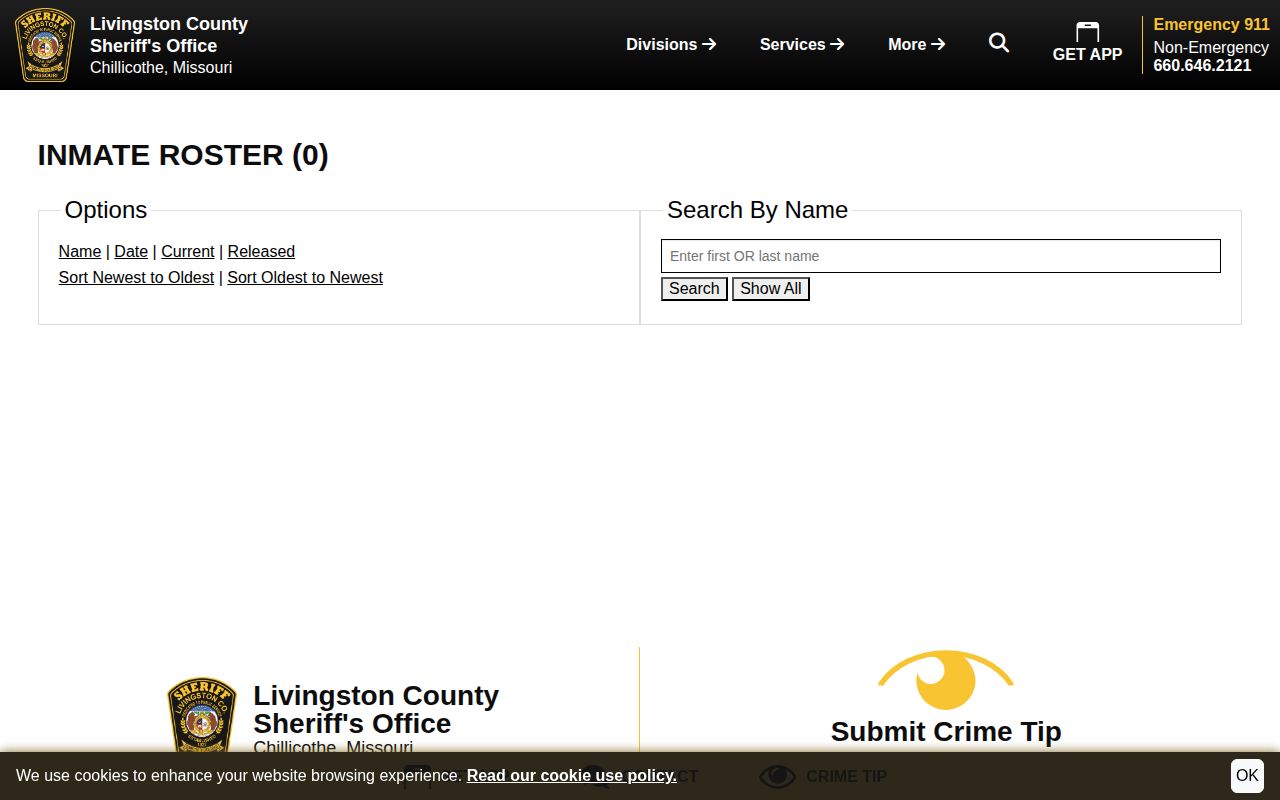
The screenshot should be read as evidence of an empty page during capture, not evidence that a defined 72-hour window had zero releases. Stronger proof is a dated release record matched to the physical jail and court event.
Request Livingston 72-Hour Records
The Livingston County Sheriff’s Office is the county-facing records contact. Ask for open portions of booking or intake and release records for the exact period. Include a person’s name, birth date if known, booking number, and case number when the request concerns one person. For a period list, identify the start and end time and request the release date, release disposition, physical custody site, and transfer destination if recorded.
Livingston County Sheriff’s Office
901 Webster Street
Chillicothe, MO 64601
Office: 660-646-0515
Monday through Friday, 8 a.m. to 4 p.m.
Dispatch: 660-646-2121
Official contact information
No dedicated sheriff release-record form or local fee table was found. Missouri permits charges allowed by its Sunshine Law, and prepayment may be required. Request a cost estimate before work begins. The state sheriff retention schedule keeps arrest and booking materials for at least five years, and inmate files with admission and release dates and transfer details for at least five years after release. Those minimums are an archival fallback, not an online publication promise.
Verify Livingston Release Records
Use each system for the custody it covers. Missouri MOVANS can provide custody-status and event notifications reported by participating agencies. Current delivery uses SMS and email after a May 2026 change. A notification is useful evidence, but it is not a certified jail release record and cannot rule out a transfer.
Case.net can show Livingston County charges, judgments, and docket entries. It may explain a bond, sentence, or court order, though it may not state the moment someone walked out of a contract jail. For a Missouri state-prison case, the MDOC active offender search includes people still under active parole or conditional release, while fully discharged people are excluded. The MDOC Sunshine data provides a historical route. A federal release belongs in the Bureau of Prisons locator, and recent immigration custody belongs in the ICE locator. None substitutes for an LCSO county-booking record.
These are parallel checks, not interchangeable databases. A MOVANS event reflects the reporting agency. A court judgment reflects the case. An active MDOC result describes corrections status, and a BOP or ICE result concerns federal custody. Only the sheriff and physical jail chain can directly answer whether a Livingston county booking ended during the chosen 72 hours and how that exit was classified.
A broader Livingston County release-record search can help connect a named person across the sheriff, jail, court, and custody systems.
Livingston Release Versus Transfer
The sheriff’s Detention Division history shows that Livingston County’s former jail closed in 2012. Most current detainees are held at Caldwell County Detention Center, and some go to Daviess/DeKalb Regional Jail for overflow, conflicts, or change-of-venue needs. The LCSO roster may name the custody site in charge text. Confirm that facility before interpreting an exit.
A transfer from Caldwell to DDRJ, a commitment to MDOC, a federal pickup, or an immigration transfer ends one facility’s custody but is not release to the community. Ask four direct questions: When did the Livingston booking end? Did the person leave the building? What disposition was recorded? Which agency received the person, if any?
- Community release
- The person leaves confinement on bond, time served, court order, or another recorded basis.
- Transfer
- One agency’s custody ends while another agency takes control.
- Parole or conditional release
- A state prisoner leaves confinement but remains under MDOC supervision.
- Final discharge
- MDOC custody and supervision end.
Note: The absence of a roster profile can also result from spelling, delay, purge, confidentiality, or transfer, so seek an affirmative date and disposition.
Public Record Search
Sponsored Results