
Livingston Parole and Probation
Parole and probation are both community supervision, but they begin in different ways. Parole is release from prison under Missouri Parole Board authority before the maximum term has expired. Conditional release is a related statutory release into supervision at a defined point in an eligible sentence. Probation is imposed by a court. A probationer may never have entered prison, so an active probation result is not evidence of a prison release.
Missouri Department of Corrections, through its Division of Probation and Parole, administers active supervision. The public search combines active prisoners, parolees, and probationers. It does not provide information on discharged offenders. The result must therefore be read as a current MDOC status, not as a complete Livingston County release history.
| Status | How it begins | What to verify |
|---|---|---|
| Parole | Parole Board authorizes release from prison. | Active MDOC status, officer, and Board record |
| Conditional release | An eligible prison sentence reaches its statutory conditional portion. | Minimum release date, later changes, and supervision |
| Probation | A court orders community supervision. | Judgment, conditions, revocation activity, and MDOC status |
| Final discharge | The supervision or sentence obligation ends. | Historical MDOC data or an official response |
- Supervision
- Monitoring and conditions administered after a court order or release from prison.
- Absconder
- A supervised person reported as having stopped required contact or left supervision without authorization.
- Revocation
- An official action that can end community supervision and return a person to custody.
- Discharge
- The formal end of a sentence or supervision term.
Verify Livingston Post-Release Supervision
The Missouri Offender Web Search is the first public check for active MDOC supervision. Search with the most exact name or identifier available, then compare identity details and the assigned status or location. Same-name results are possible. A parole or conditional-release status supports release from prison into supervision. A probation result needs court context because it does not establish prior prison custody.
- Search the person in the active MDOC system and compare the full name, identifier, and available identity details.
- Read whether the result reflects prison custody, parole, conditional release, or probation.
- Check Case.net by litigant name or cause number for the judgment and later supervision orders.
- Use the listed caseworker or field office for a specific current-status question.
- If the person is absent, check historical MDOC data or request a discharge record instead of assuming the reason.
The nightly MDOC Sunshine file covers people who are or have been supervised. Its rows are charge based, so one person may appear more than once. Match the DOC ID, cause number, offense or sentence county, and completed flag. Livingston County is coded LIVI. A completed flag marks a sentence row as complete, not the exact moment a person left a facility.
No active-search result can be treated as a dated discharge finding without checking the historical file or MDOC.
Livingston Supervision at District 2
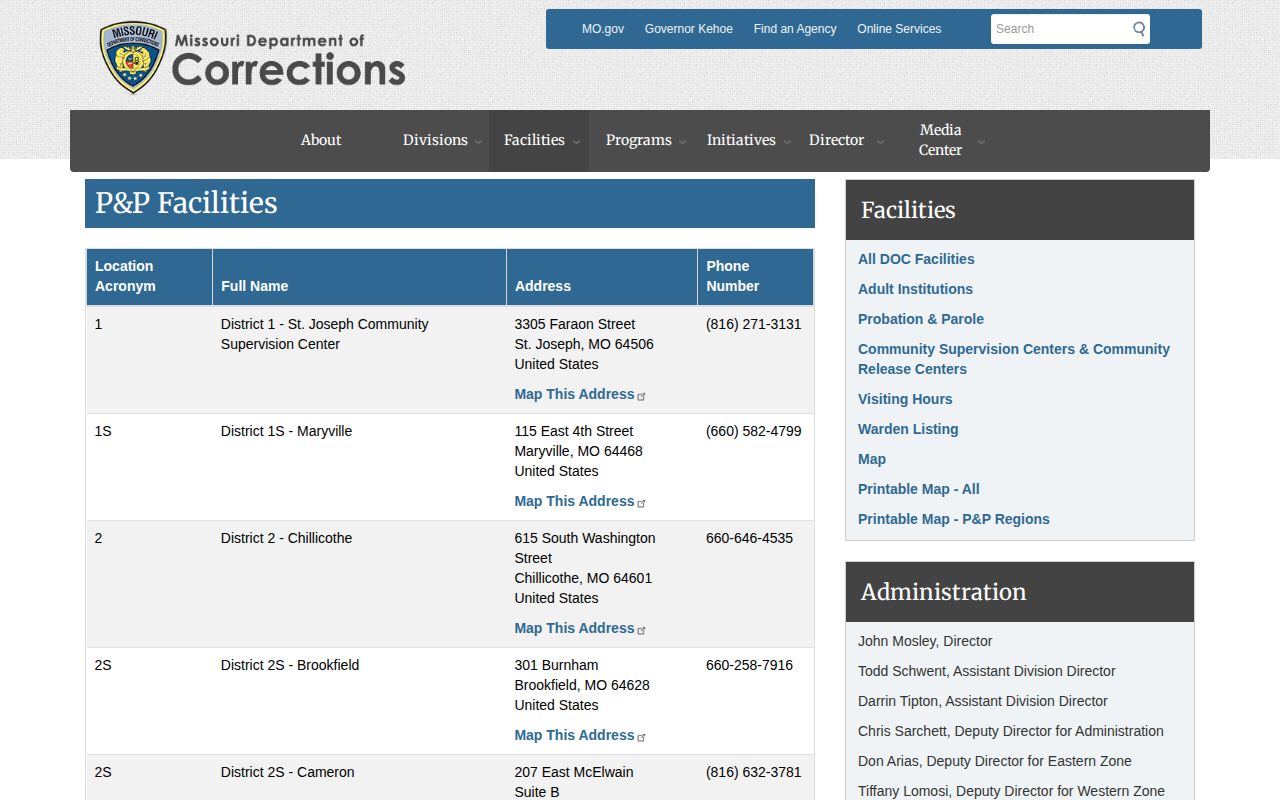
The state directory identifies District 2 - Chillicothe as the probation and parole office physically located in Livingston County. That gives a local route for questions about an active result, assigned supervision, or the proper office. The official listing does not publish public hours and does not state that the office is an all-purpose records custodian for every case. Call before visiting and provide the person’s correct spelling, DOC number, and date of birth when available.
District 2 - Chillicothe
Missouri Division of Probation and Parole
615 South Washington Street
Chillicothe, MO 64601
660-646-4535
Public hours not stated in the official directory
The official directory image confirms the Livingston County office location and telephone route.
Use District 2 to clarify active supervision, not as a substitute for LCSO’s county-jail release record.
Livingston Supervision Conditions
Conditions come from the court, Parole Board, and supervising agency. They can require contact with an officer, approved residence or travel, program participation, reporting, and compliance with the law. The exact terms belong to the individual order and case. A public status page cannot supply a complete set of conditions, and general descriptions should not be treated as the person’s actual order.
A violation allegation can lead to closer review, a warrant, a hearing, or revocation. Those stages differ. A warrant listing means the person is wanted, not necessarily in custody. LCSO maintains a local warrant route that can add current context after a past release. Case.net may show probation activity, revocation proceedings, or later orders. MDOC can clarify supervision status within the limits of public access.
Missouri MOVANS may report a custody or court event, but it does not certify the person’s status across all agencies. Current notifications use text or email. Phone and VINELink-app delivery ended in May 2026. Local jail and court help is handled through Missouri’s MOVANS contacts, while MDOC Victim Services handles notification registration for people under corrections supervision.
Livingston Absconder and Warrant Checks
An absconder is a supervised person reported as no longer maintaining required contact. The term does not mean that a new conviction occurred. It also does not prove current confinement. Check the active MDOC result, then compare it with the supervising office and any public warrant information. If a warrant exists, the issuing source and court record can help distinguish an allegation, a supervision response, and an actual custody event.
The Livingston County sheriff warrant page is a local status source. A past release does not rule out a later felony, probation-violation, domestic-assault, or child-support warrant. Conversely, a listed warrant does not show that officers have taken the person into custody. A current roster or confirmation from the responsible agency is needed for that separate question.
Note: Supervision status, wanted status, and custody status answer three different questions and should be checked through their own official sources.
Livingston Earned Compliance Credit
Missouri’s Earned Compliance Credit, or ECC, affects eligible post-release supervision. It is not prison good time and does not calculate when an incarcerated person leaves prison. Under section 217.703, an eligible compliant person may receive thirty days of credit against the supervision term for each full compliant calendar month. Absconders do not earn the credit, and credits can be suspended or rescinded under the statute.
ECC can move the end of supervision earlier. That may cause a person to disappear from the active offender search after discharge. The disappearance still is not a dated proof of when supervision ended. Historical MDOC data, the field office, or a focused Sunshine request is the sound route for the discharge record. Prison minimum-release calculations follow different laws and records.
| Credit or date | Stage affected | What it is not |
|---|---|---|
| Earned Compliance Credit | Eligible community supervision term | Prison good time |
| Minimum release date | Conditional-release point in an eligible prison term | Final discharge |
| Maximum release date | Full court-term expiration | A promise of the actual door date |
Livingston Parole Board Records
The Missouri Parole Board controls parole decisions under state law. Eligibility does not guarantee release. Official process material says the Board considers institutional conduct, adjustment, programs, and other relevant circumstances. A result may set another hearing in one to five years or establish a future release date. Decisions normally take about eight to twelve weeks after the hearing process, but that estimate is not a release promise.
No public statewide calendar of named upcoming hearings and no public decisions search were found. For a specific hearing or decision, use Board Operations, institutional parole staff, an eligible notification channel, or a Sunshine request. Parole Board records requests go to ParoleBoard.SunshineRequest@doc.mo.gov. General Board contact is 573-751-8488 or DOC.MissouriParoleBoard@doc.mo.gov.
Missouri section 217.690 supplies the Board’s parole authority and eligibility framework. Consecutive minimum terms can aggregate, and special or excluded cases may follow different rules. A guideline, hearing date, or eligibility point does not guarantee that a release date will be set. Even after a future date appears, institutional conduct, another sentence, a detainer, or a later Board action can affect the path. The individual decision and current MDOC record are more reliable than a general estimate.
Public court records add another layer. Case.net may show a sentence, probation order, revocation filing, or later judgment, but protected parties and confidential records can be absent. Only linked docket entries are remotely viewable as documents. A court order can establish legal authority for supervision or release without recording the precise change in MDOC custody. Compare the docket with the active offender result and the responsible office before treating either source as complete.
The official parole-hearing process explains the review and possible outcomes.
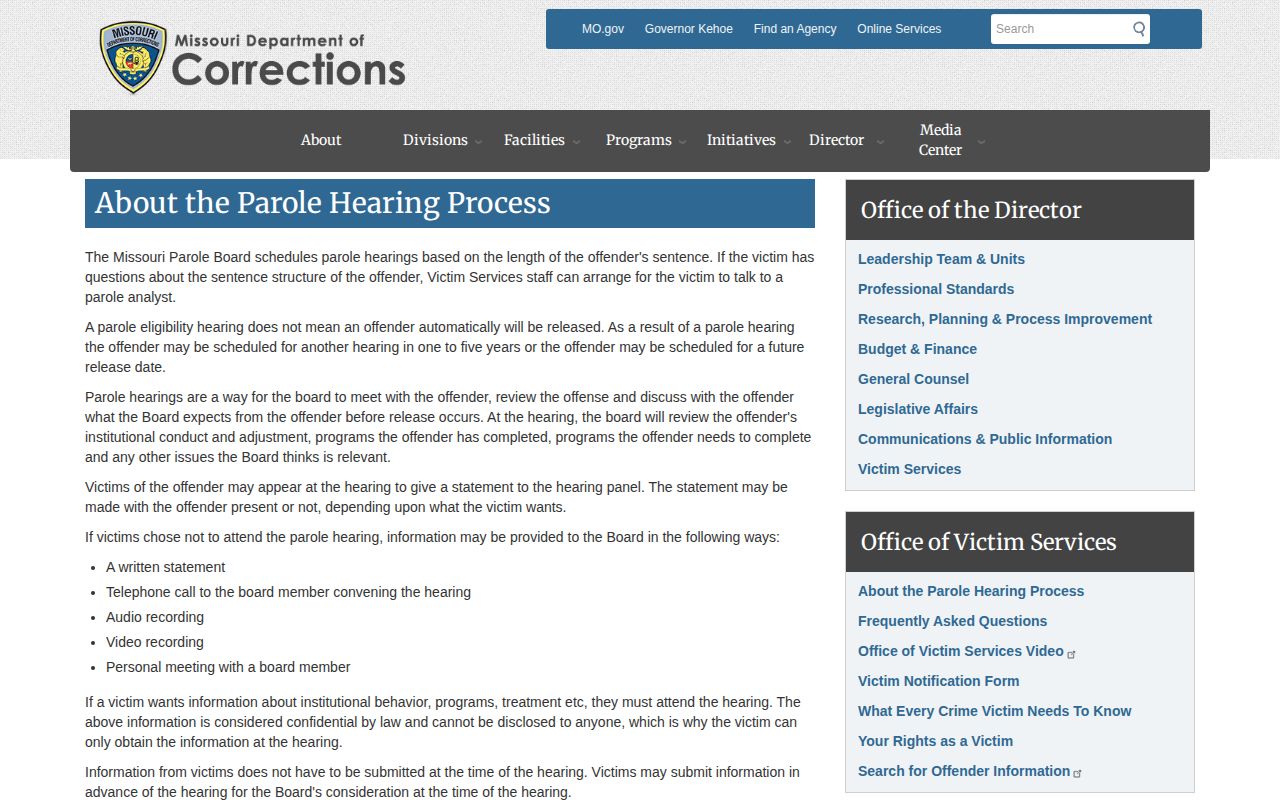
The process source supports timing and broad outcomes, not a public person-by-person release calendar.
Confirm Livingston Supervision Discharge
Supervision ends through a formal discharge, not through silence from a search page. Begin with the active offender system. If the person is absent, use the nightly historical file and match the DOC ID and case information. A completed sentence row can support the research, but ask MDOC for clarification when the question is the exact discharge status or date.
Send MDOC Sunshine requests to OD.SunshineRequest@doc.mo.gov and ask for releasable discharge or status records. Include the full name, DOC number, date of birth, and cause number when known. For a Livingston County jail exit, return to LCSO and the physical contract jail. The state supervision record and the county release record document different events. The home page’s Livingston County release-record process explains how to request the local exit disposition and destination.
Public Record Search
Sponsored Results