
Livingston Released Mugshot Records
A booking photo is created during an arrest or intake event. It belongs to that event and custodian. Release does not turn it into a new photo or prove what happened in the case. A person may have more than one Livingston County booking, and a county photo differs from an MDOC institutional image. Match the booking number, arresting agency, booking date, and case number whenever those fields are available.
Missouri §610.100 treats arrest reports as records that include arrest and detention or confinement information. Arrest and incident reports are generally open, while investigative material can remain closed. If no charge follows within the statutory period, portions can close. That means a booking photo should be requested as a specific record, but public release is still subject to the custodian’s legal review. It should not be promised merely because the image once appeared online.
Retention and web display are also different. Missouri’s sheriff schedule gives arrest and booking material a five-year minimum, while inmate files that include admission and release dates have a minimum of five years after release. The schedule supports a later request. It does not require the LCSO website to preserve a mugshot for that entire span.
Find Livingston Released Booking Photos
The strongest channel is the agency that created or maintains the image. Livingston County uses contract jails, so LCSO may hold the county booking index while Caldwell County Detention Center or DDRJ holds physical-custody material. Ask both when the custodian is unclear. The local current roster proves that booking photographs are displayed for current detainees. The Released view was empty when researched, so a claim that released profiles keep their photos would be unsupported.
| Channel | Has a photo? | How to access |
|---|---|---|
| LCSO current roster | Yes, on observed current cards | Use only to identify a current booking and physical jail. |
| LCSO Released filter | Unverified after release | Search by name and date sorting, but do not assume photo persistence. |
| LCSO or physical-jail request | Possible after review | Request the named booking photo with booking number and date. |
| MDOC | Possible by separate request | Ask DOC for a releasable offender photograph, not a county mugshot. |
| Official press or social post | Sometimes | Search selected official incident posts; coverage is not complete. |
| Sheriff app | No supported current channel | Both advertised store options are still marked coming soon. |
| Third-party copy | Possible but unreliable | Use only as an identity lead and verify with an official record. |
VINELink or Missouri MOVANS may show optional identifying information in a live record, but exact Livingston photo display was not verified. Its main role is custody status and notification, not photo archiving. Likewise, the DOC Sunshine ZIP contains no image field. A downloaded sentence row cannot supply a photo.
Livingston Roster Photo Evidence
The official LCSO Current roster visibly includes a booking image, name and profile, booking number, age, booking date, charges, custody-site text, and bond on current cards. This is proof of the present-custody layout only. It should not be used to claim that the same fields or image remain once the card moves to Released.
On July 26, 2026, the official Released filter showed “Inmate Roster (0).” No released card was available to inspect. The filter offers Released versus Current, search by first or last name, and name or date sorting. It does not publish an archive window or purge rule. A zero count cannot show whether a person was never booked, whether older entries were removed, or whether a temporary data issue existed.
The current roster image documents the layout used for Livingston County bookings:
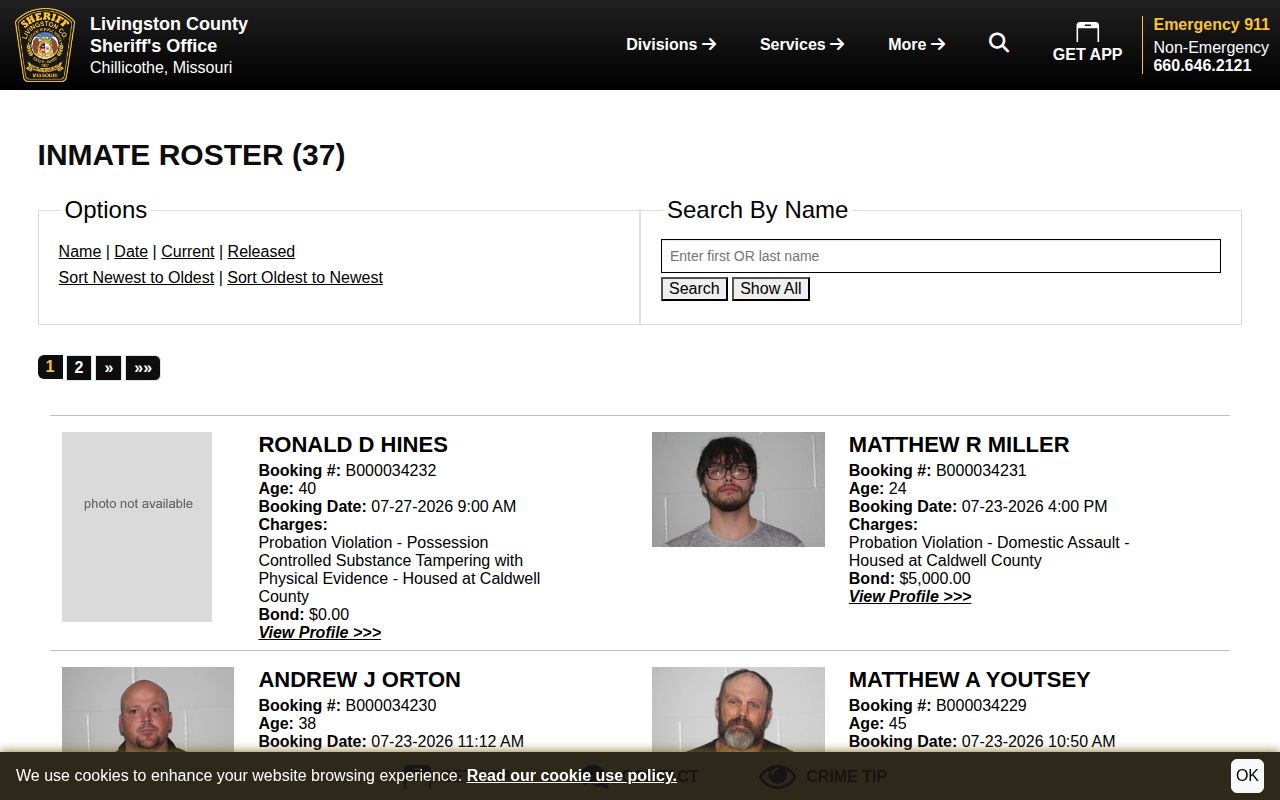
Use that screenshot only for the current-card evidence. The Livingston County 24-hour releases page explains why the Released filter is not a defined one-day archive.
Livingston Sheriff App Has No Photos
The Livingston County Sheriff app page shows both store badges as “coming soon.” No working download or app-only release and photo feature can currently be supported. This is a useful local negative because sheriff apps in other places sometimes expose roster images. Livingston’s page does not provide that route.
Do not follow old app claims from an unrelated county or a copied directory. For Livingston records, use the official web roster or ask the records custodian. A future app could change the access channel, but it must be verified from a live official store listing before readers are told it shows booking photographs.
The official app status was captured directly:
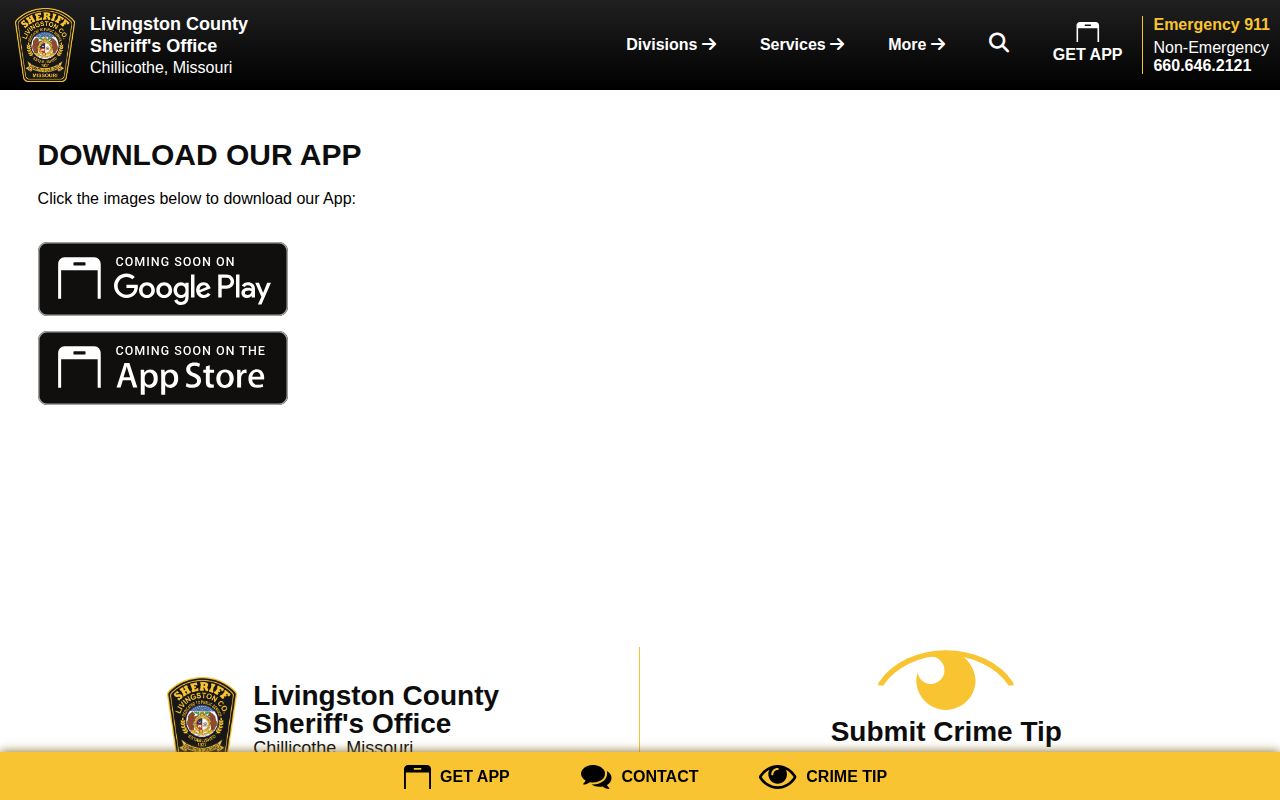
As of the research date, neither store badge led to a usable Livingston release-photo tool.
Request Livingston Released Booking Photos
A focused Sunshine request is the best fallback after a Livingston County released mugshot leaves the web roster. Send the request to LCSO and, when needed, the contract jail that physically held the person. LCSO publishes no dedicated booking-photo form or local photo fee schedule. Ask for electronic copies and a cost estimate before charges are incurred.
- Identify the person by full name and, if known, date of birth, booking number, and booking date.
- Name the physical facility shown in the booking record, such as Caldwell County Detention Center or DDRJ.
- Request the open booking or intake photograph tied to that specific booking event.
- Also ask for admission and release date and time, release disposition, and destination so the image is matched to the correct exit.
- Request segregable open portions if part of the file is closed, and ask the custodian to cite the law used for any denial.
- Prefer an electronic image and ask for a cost estimate before nonpaper or research costs are incurred.
Under §610.023, the custodian must act by the end of the third business day. The rule does not guarantee delivery in three days. A reasonable delay must be explained with the earliest availability. Current §610.026 governs allowable copy, research, and nonpaper or picture costs and permits prepayment in some cases.
Livingston Mugshots Versus MDOC Photos
A county booking photo and an MDOC offender photograph come from different custodians. The county image documents the arrest or jail intake. A DOC image relates to state corrections. A person can have both, and the images may have been taken years apart. Request the one tied to the record being verified.
MDOC’s active offender search is limited to active offenders, including probationers and parolees. It omits discharged offenders. The historical Sunshine file covers people who are or have been supervised, but its published layout has no photo field. For a releasable institutional photograph, contact the DOC Sunshine custodian and ask for the offender photo specifically. Include the DOC ID and cause number where known.
An active probation result does not establish a prison release because probation can be imposed without imprisonment. A parole or conditional-release result can support community supervision after prison, subject to the actual record. Keep the photo question separate from the release-status question so the image is not treated as proof of custody.
Official Livingston Photo Posts
LCSO press releases and its official social feed may include a photograph tied to a selected incident. These posts are not a complete booking archive. They can omit routine arrests, use an image other than the jail mugshot, or remain online after custody and case status change. Match a post to the case and booking record before using it to identify the person.
Local news and third-party aggregators may copy a booking image. Such copies can be stale, mislabeled, or detached from a correction or expungement. They should be treated only as leads to identifiers, never as the sole source of a released status. No commercial mugshot publisher, data broker, or paid removal service is endorsed or linked.
Missouri Mugshot Payment Ban
Missouri §407.1150 does not impose a blanket ban on publishing booking photographs. It prohibits a publisher or disseminator of criminal-record information, including a Missouri booking photo, from soliciting or accepting payment from the subject to remove or correct the information. The statute provides criminal and civil consequences within its stated scope.
That rule should not be rewritten as a right to make LCSO keep a released photo online, a universal removal right, or a ban on all mugshots. It addresses the pay-to-remove practice. A correction request to an official agency must identify the precise error and include the booking number or record link when possible.
Correct Livingston Released Mugshots
Start by preserving the URL, screenshot, access date, and exact field that is wrong. Contact LCSO when the error appears in its roster or booking index. Contact the physical jail if it created the disputed intake image. MDOC handles its own records, and the circuit court handles errors in court documents. One office may not have power to alter another custodian’s file.
Expungement can close covered records, but it does not mean every copy is physically destroyed. Under §610.140, current general waiting periods after completion are three years for an eligible felony and one year for an eligible misdemeanor, municipal offense, or infraction, subject to all statutory requirements. Eligible arrest-only relief generally has an eighteen-month minimum. The petition must name the entities holding the records.
When an expungement order covers the booking, provide the order to each named custodian and ask how it applies to the displayed image. For an inaccurate photo or identity match, state the correction sought without asking the agency to change a valid court judgment. A third-party copy may persist after the official source changes, which is another reason to rely on the originating record.