
Former Jail Release Records
No present-day inmate is released from the old Livingston County Jail. The facility opened in 1978, had 48 beds across ten cell areas, and closed on December 31, 2012 after repair funding problems. Its Webster Street address remains the Livingston County Sheriff’s Office address, but the building must not be described as the current county jail or a modern release pickup point.
For a booking that occurred while the jail operated, LCSO is the logical records custodian. A useful historical file may connect the person’s identity, booking number, arresting agency, admission date, charges or case number, release date, disposition, and destination. Not every field will be open or stored in one place. The court docket may add context, but it does not replace the jail record’s physical exit time.
Current Livingston Release Route
The LCSO Detention Division history explains the change from a local jail to contracted beds. Caldwell County Detention Center in Kingston is the primary custody site. The Daviess/DeKalb Regional Jail in Pattonsburg is used on a smaller basis for overflow, conflicts, and changes of venue. A current Livingston release can physically occur in another county even though the sheriff maintains the county-facing roster.
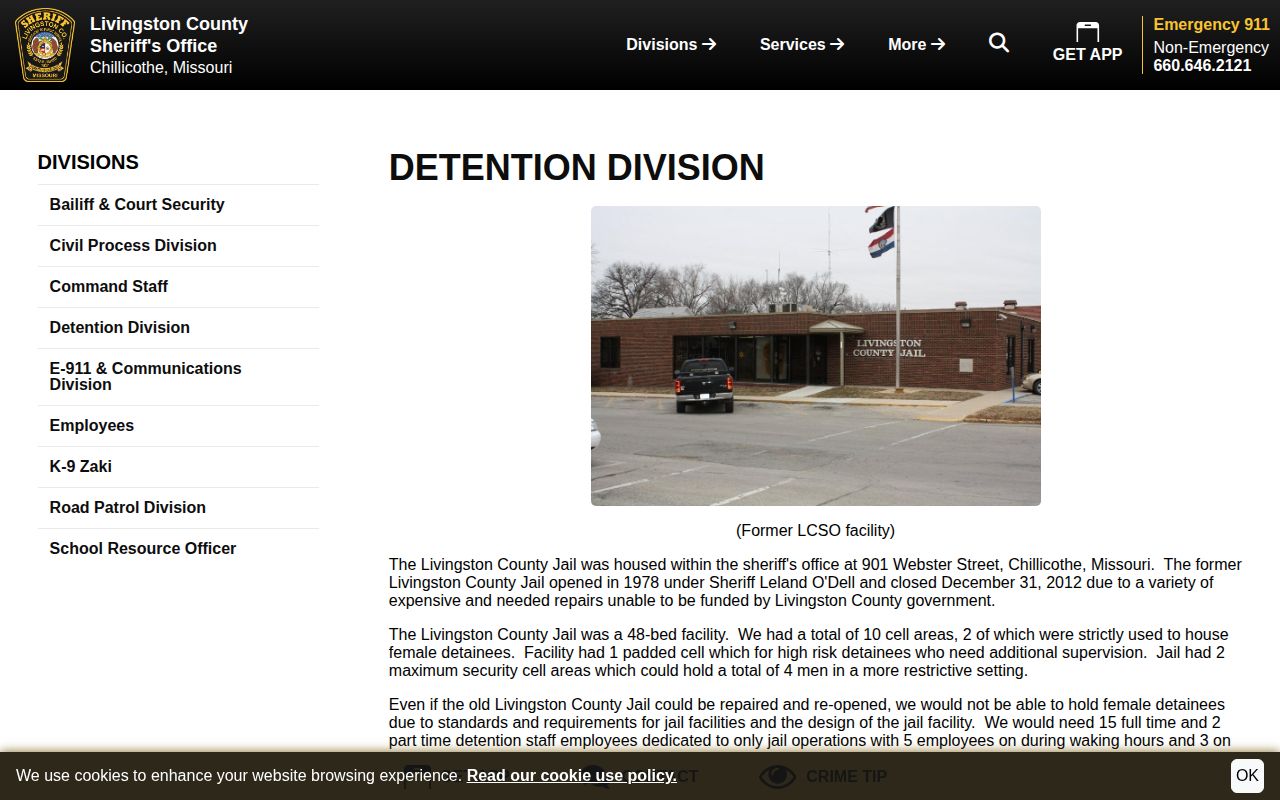
The official source confirms why a present-day search must identify the jail that holds the person before anyone calls or travels.
Begin with the LCSO Released view. Search by either first or last name, sort newest first, and note any booking number or placement information. Check Current only to see whether the person remains held and where. Then contact Caldwell or DDRJ, as shown by the record. A move from one jail to another ends custody at the first building but is not release to the community.
The Livingston County release search covers the full county verification route. For a current event, the old jail’s history explains the system but does not supply the physical release record.
Request Former Jail Release Records
A narrow request is more useful than asking for every file tied to a common name. Give LCSO the full name, aliases if known, date of birth if appropriate, approximate booking period, and case or booking number. State that the request concerns the former jail. Ask for open portions of the booking and release file in electronic form and request a cost estimate before charges are incurred.
- Identify a date range when the former Livingston County Jail was still operating.
- Match the person to a Livingston court case or known booking number where possible.
- Ask for admission and release dates and times, release disposition, and destination or receiving agency.
- Request segregable open portions if part of the file is closed.
- Reconcile the response with Case.net when a court order, dismissal, or sentence helps explain the exit.
Under Missouri section 610.023, the records custodian must act by the end of the third business day. Production can take longer when there is reasonable cause, and the response should explain the delay and earliest availability. This rule does not promise delivery in three business days.
Current section 610.026 permits certain copy, clerical, research, photo, and media costs. Standard paper copies may cost up to ten cents per page plus allowed clerical time, while nonpaper items can be priced under the statute. Prepayment may be requested. LCSO publishes no separate local release-record fee table, so ask for an estimate.
Former Jail Records Contact
The sheriff’s office is the county records route for material from the former jail. Its office hours apply to administrative contact, not inmate release processing. Dispatch serves a different function and should not be used as a substitute for a focused records request unless an immediate custody-status question requires the published dispatch line.
Livingston County Sheriff’s Office
Former Livingston County Jail records
901 Webster Street
Chillicothe, MO 64601
Office: 660-646-0515
Monday through Friday, 8 a.m. to 4 p.m.
Lobby closed on major holidays
Dispatch: 660-646-2121
No dedicated LCSO release-record form or local fee schedule was found in the official sources reviewed as of July 26, 2026. The city police request form belongs to Chillicothe Police and should not be sent as though it were the sheriff’s form.
Livingston Historical Record Retention
Missouri’s local records schedule gives older jail research an archival path. SHF 006 covers arrest logs, files, registers, fingerprints, and booking sheets with a minimum retention period of five years. SHF 013 covers inmate or detainee files, including intake, reasons for confinement, admission and release dates, property receipts, and transfer information. Those files carry a minimum of five years after release.
| Record group | Examples | Minimum |
|---|---|---|
| SHF 006 arrest records | Arrest log, booking sheet, fingerprints | Five years |
| SHF 013 inmate files | Admission, release, property, transfer | Five years after release |
A minimum schedule is not a promise that every record from the jail’s full operating life still exists or is open online. Litigation, local practice, and other legal duties may affect retention. A missing web result does not mean the historical record was never made.
Expungement or confidentiality can also affect remote access. A closed Missouri record is not necessarily destroyed. When a court result is missing, ask the custodian to search the date and booking identifiers rather than treating the absence as proof of a specific outcome.
Older records may use names, formats, or index fields that differ from the present roster. Supply aliases and an approximate arrest date, and distinguish the arrest date from the booking or release date. When one file contains only a disposition while another contains the exit time, preserve both rather than forcing them into a single date. A completed court case proves a legal outcome. It does not by itself show whether the former jail transferred the person before the case ended.
Livingston Jail Closure Legacy
The old jail’s 48-bed limit and 2012 closure shaped the present release system. A sheriff statement published in 2025 reported a 2024 average daily Livingston detainee population above 50 and contract detention expense above $1 million. The figures help explain the continued use of two out-of-county jails. They are not a count of unique detainees, bookings, or releases.
That history creates two record layers. LCSO maintains the Livingston-facing booking and roster role. Caldwell or DDRJ holds the physical-custody details for a current detainee. A sound request names both the county booking and the actual jail, which reduces the chance that one office will answer only its part of the event.
There is no verified regular release time, exit door, property procedure, local passenger bus route from the contract jails, or county release transport program. Those gaps matter. Families should confirm the current custody site and ask that facility for the precise release logistics rather than using the former jail as the default destination.
The modern roster can still help with older research by showing the sheriff’s role as the Livingston-facing booking source, but it should not be treated as the archive for pre-closure custody. The Released filter’s public retention and cadence are not stated. If an older person does not appear, move to a direct LCSO request, Case.net, and the relevant paper or electronic index. State the access date for every dynamic search so a later reader can distinguish a checked result from a permanent claim.
Read Former Jail Release Entries
Release types should be read narrowly. Bond means detention ended while the criminal case continued. Time served or sentence completion concerns a custody sentence but should be checked against the judgment. A dismissal may explain why a person was eligible to leave without showing the exact time they crossed the jail door. Transfer means custody continued under another agency.
- Release disposition
- The recorded reason or legal basis for the jail exit.
- Destination
- The community or agency to which the person was released or transferred.
- Discharge
- The end of a sentence or supervision term, which is not always the same date as a jail exit.
- Detainer
- A request or legal basis for another authority to take or continue custody.
A dated former-jail record can prove the end of that Livingston custody event. It cannot by itself establish that no later jail, prison, supervision, federal, or immigration custody existed. State and federal systems must be checked only when the facts point to those separate forms of custody.